
Why We’re Drawn to Authentic People (and How to Be One)
Aspiring to realness in an age of artifice

I’ve been thinking a lot lately about authenticity.
How we feel drawn to it in others.
How we aspire to it in ourselves.
A person who acts authentically feels, to me, like someone who is not as easily buffeted by peer pressure and group influence. Someone who says what they mean. Someone whose actions you can expect to align with their values. Someone who will tell you how they’re actually doing. And someone who genuinely cares.
Authenticity means honesty. We crave realness. We don’t want to see a curated and perfect version of someone else’s life. We don’t want the answer, “I’m fine, how are you?” when we seek connection. We want humanity in all its imperfections. We want to see something flawed and imperfect in others, because it reminds us that our own flaws and imperfections are okay.
Authenticity connotes acceptance. Authentic people accept and love you just as you are. They put out honesty into the world and expect it in return. Research validates this intuitive truth: people who experience greater authentic self-expression also report greater compassion for themselves1 and greater compassion for others2, most likely because authenticity reduces defensiveness, increasing acceptance of both our own and others’ flaws. It follows, then, that authentic people also have stronger relationships3.
Authenticity also aligns with depth. Authentic people will have a real conversation with you. They’ll share their hopes and fears for their lives. They’ll share stories of their childhood. They’ll reflect on their own shortcomings. They aren’t content with maintaining shallow connections.
Friendships are some of the most significant relationships we have in life, and when we are authentic with each other, our bonds are stronger. Friendship characterized by authenticity can withstand moves and distance and sporadic communication. These are the kinds of friends where you can pick right back up where you left off whenever you see each other next.
Authenticity is the main quality that links the people I’m closest with. It’s what draws me to them. Authentic people can be a little grumpy or disillusioned. They aren’t perfect. They can be anxious or self-conscious — but they are honest about that. They won’t pretend to be okay if they’re not. And if life is good, they will share that, too, with genuine joy. Authenticity necessarily involves vulnerability and emotional complexity. Research has found that people who present themselves in an overly positive way seem less authentic to others compared to those who present a mixed or even negative self4. What matters most is this quality of realness, of unfiltered honesty.
Authenticity is owning your story.
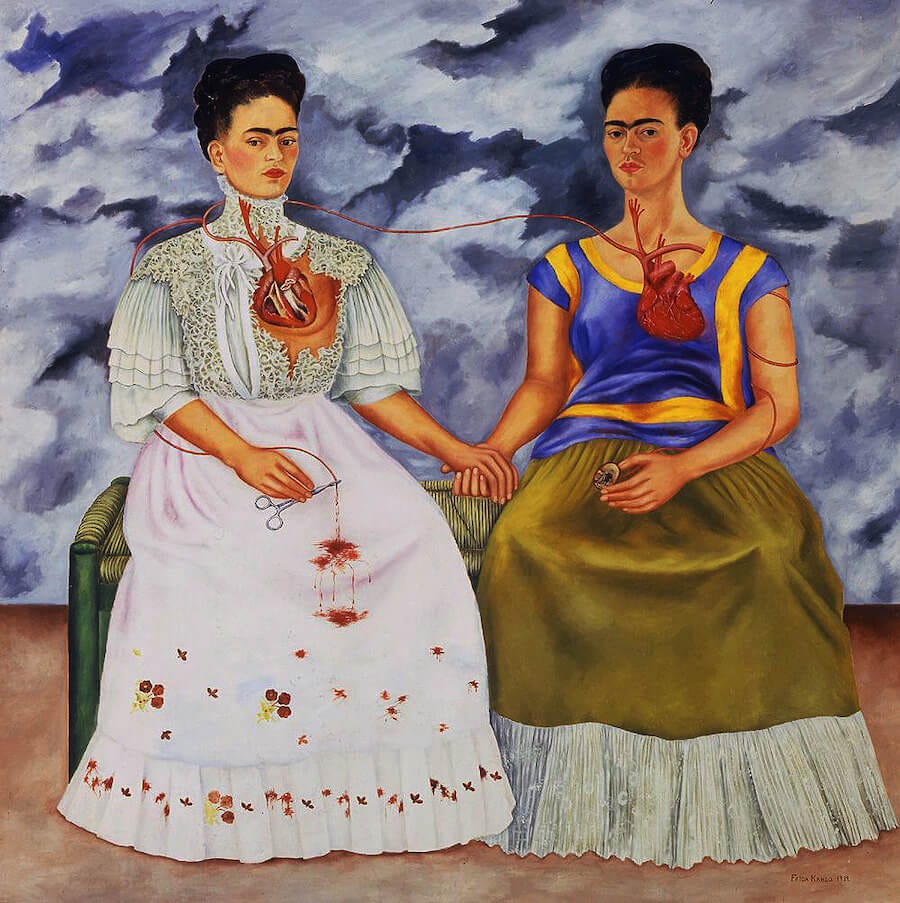
Even ugliness can be beautiful in its authenticity, in its unapologetic truth. For example, Frida Kahlo’s stunning self-portraits were often raw and emotionally intense, depicting physical pain, miscarriage, infidelity, and disability. Her work is praised and even revered for its bold, authentic expression. And in Hunger: A Memoir of (My) Body, Roxane Gay writes openly about trauma, body image, and shame. Her prose is intentionally uncomfortable at times, and she refuses tidy resolutions or redemption arcs, making space for what’s ugly, unresolved, and real. The result is powerful and freeing, and an invitation for the reader to connect with their own imperfections.
When we feel safe being authentic
I’ve been talking about “authentic people,” as though authenticity were a quality that people possess to varying degrees, which isn’t wrong — some people are generally more authentic across contexts than others are. They’re less concerned with monitoring their behavior to fit with what they think others want5. However, authenticity is also something that people can feel more in some situations—or with some people—than in others.
When people feel authentic, they have a strong and stable sense of their own worth6. They feel less defensive and more secure in their attachment style7. They feel more contentment, calm, and satisfaction8. They’re more likely to be happy and to find meaning in life9.
People feel more authentic when they lean into their character strengths10. I love seeing someone lit up by their strengths, by what makes them and their perspective on the world unique. I am greedy about this. I want raw, unfiltered truth. I want surprise. I want nuance. That interests me so much more than the blandly positive and inoffensive.
Let’s look at two portraits of people who show up as their full selves in my life:
Sam is an artist in every sense of the word. She’s someone who can show you the beauty in everyday objects. She curates her life with beauty, great food, and mementos that carry stories and memories, and I love how intentional she is about this. She cares deeply about her friends and family. She has a big heart. She worries constantly about her loved ones and has a hard time being direct for fear of offending others. She is going to be an incredible mom.
Danny is insatiably curious and has a deep love of learning. He loves putting things together and learning how they work. He’s the kind of person who can teach himself software engineering in a month. He’s insanely smart yet also deeply humble. He’s quirky and finds humor in wordplay and shared cultural references: he takes others’ humor and makes it his own. He’s deeply creative. He is tuned into his sense of touch, enjoying textures and fidget toys. He’s a kind, gentle, and giving person and always wants to do things to help others. He loves giving and receiving affection and validation. He shines in the light of others’ appreciation.
When people show you their full selves, they’re rich with detail and complexity, even contradiction. They’re human.
Why aren’t we always authentic?
Good question, and I have three thoughts in response.
1. We’re worried about what others will think of us
Many of us worry about offending others, saying or doing the wrong thing, being rejected. So we conform.
Some of these worries can come from a chronic tendency toward people-pleasing, a pattern of behavior in which people (more often women) prioritize others’ wants and needs over their own wants and needs so as to gain approval or avoid conflict. This can lead the people-pleaser to sabotage their own well-being in order to make others happy. “Midwest nice” describes people socialized to be agreeable, nonconfrontational, and at times overly apologetic. My partner Danny grew up in Ohio; the early years of our relationship were spent figuring out how his (non)confrontation style meshed with my direct and assertive Californian upbringing.
Other worries go beyond people-pleasing. There are many social situations in which it feels risky to be real. Some of these situations involve explicitly being evaluated or judged by others, like interviews, first dates, and social media. There are also many more situations in which we simply worry about the possibility of being judged, or that we will accidentally offend others. This fear of negative evaluation can lead us to filter, distort, downplay, or otherwise talk ourselves out of being direct and acting in alignment with our feelings and values, or to engage in impression management by trying to seem impressive or desirable to others.
A more extreme version of this is masking, is a set of strategies some people use to hide, camouflage, or compensate for their unusual traits or behaviors so they can blend in and be more accepted by others. In the autistic community, these experiences are called autistic masking. Autistic people talk about masking their autistic traits as a survival strategy. For example, while masking, they might not engage in repetitive, self-calming movements, or they might force themselves to maintain eye contact with others. However, masking can come at a high cost, including feelings of exhaustion, pain and discomfort, depression, anxiety, low self-esteem — and, of course, inauthenticity11.
“When I am consciously masking it takes so much of myself to do it. I lose who I really am. I feel disconnected and at a loss. I feel robotic and forced. I see this shiny version of me from the outside. … It’s exhausting. It reminds me that I am not enough as myself but I must encompass this forcibly fake existence that drains me.”
—Rosie Weldon, Autism and masking
2. We want to protect ourselves from feeling bad
People withhold aspects of themselves to avoid feelings of shame, embarrassment, or vulnerability. We may also deceive ourselves or others to feel good about ourselves, especially when our truth conflicts with social or moral ideals12. For example, people who act dishonestly will often maintain a positive self-image by rationalizing their behavior, like cheating “just a little”13.
And y’all, I’m not going to mention shame and vulnerability without at least a hat tip to Brene Brown. Her writing and public outreach, especially her first TED talk, “The Power of Vulnerability,” has done so much to raise public consciousness about the importance of being vulnerable. (My favorite book of hers: Atlas of the Heart, a taxonomy of emotions and their functions.) Based on her research, Brown argues that although being vulnerable is precarious and difficult, it is is necessary to be able to experience joy, creativity, belonging, and love. She suggests that if we allow ourselves to be vulnerable with our imperfections, we can more strongly connect with others.
“You cannot selectively numb. When we numb [hard feelings], we [also] numb joy, gratitude, happiness.”
—Brene Brown in “The Power of Vulnerability”
3. Authenticity isn’t appropriate for the situation or role we’re in
Even when we’re willing to be vulnerable, sometimes we can’t show up as our full selves because it wouldn’t be appropriate for the norms of the situation or social role we’re in – like at work, in parenting, or when playing to the expectations of cultural or gender roles.
Many of us have social roles that involve a great deal of emotional labor and surface acting. As a parent of young children, I often pretend to be playful when I am actually frustrated, because being playful is what will get my kids to do what I’m asking. Similarly, service workers often have to hide their true feelings at work, acting endlessly friendly, patient, and helpful even when customers are dismissive or outright rude. I was a server at a sushi restaurant for three years, so I can strongly relate to this. (Yes! I would be so happy to seat you and your large group of friends at closing time even though I have been dead on my feet for hours!)
There are also cultural differences in self-expression. Psychological research often contrasts the perspectives of people from Eastern cultures (e.g., many parts of Asia), which value maintenance of social order and hierarchy, with people from Western cultures (e.g., the U.S. or Western Europe), which value individuality and assertiveness. One major finding is that people from Eastern cultures tend to suppress their emotions more than people from Western cultures14. The effects of emotion suppression tend to fit with the cultural values people have: suppression has more negative social and emotional consequences for people with Western values and more positive consequences for people with Eastern values15.
Finally, people may not be able to be authentic in a given context due to their group memberships, such as gender or race. Jodi-Ann Burey, a writer and critic about race, culture, and health equity, has a great TEDx talk explaining why people of color and members of other marginalized groups can’t actually bring their full, authentic selves to work because they end up being punished for it – like being overlooked for promotions or even fired for not being “agreeable.” Instead, people with power and privilege need to change workplace culture by aligning their stated values of inclusion with how people of color are treated in the workplace.
Conclusion: Increasing authenticity
If authenticity is a practice — something we move in and out of, depending on how safe we feel, how much we trust ourselves, and how much space the world gives us — then we can keep choosing it. We can choose authenticity by seeking out spaces and people that feel safe. By allowing ourselves to be vulnerable. Asking for help. Saying “I’m not okay.” Setting boundaries gently. In doing this, we reclaim pieces of ourselves, we invite support when we need it, and we give others permission to do the same. And the more we practice, the more real life becomes.
Of course, not everyone gets to be fully authentic without consequences. That’s why authenticity is, in part, a collective project. Those of us in positions of relative power and privilege (everyone has at least some) can also create environments for others that allow them to show up authentically. As leaders and managers, as policymakers, as union members, we can build systems that truly value and reward diversity and inclusion. Authenticity can’t just be about “being yourself” for people whose whole selves aren’t intrinsically valued. It has to include creating spaces where everyone’s self is welcome.
Zhang, J. W., Chen, S., Tomova, T. K., Bilgin, B., Chai, W. J., Ramis, T., Shaban-Azad, H., Razavi, P., Nutankumar, T., & Manukyan, A. (2019). A compassionate self is a true self? Self-compassion promotes subjective authenticity. Journal of Personality and Social Psychology, 117(2), 421–453. https://doi.org/10.1177/0146167218820914
Bayır-Toper, A., Arslan, G., & Allen, K.-A. (2022). Being yourself for the ‘greater good’: An empirical investigation of the moderation effect of authenticity between self-compassion and compassion for others. Current Psychology, 43, 1324–1332. https://doi.org/10.1007/s12144-020-00989-6
Kernis, M. H., & Goldman, B. M. (2006). A multicomponent conceptualization of authenticity: Theory and research. Advances in Experimental Social Psychology, 38, 283–357. https://doi.org/10.1016/S0065-2601(06)38006-9
Bailey, E. R., & Iyengar, S. S. (2023). Positive—More than unbiased—Self-perceptions increase subjective authenticity. Journal of Personality and Social Psychology, 125(6), 1351–1372. https://doi.org/10.1037/pspa0000359
Pillow, D. R., Hale, W. J., Crabtree, M. A., & Hinojosa, T. L. (2017). Exploring the relations between self-monitoring, authenticity, and well-being. Personality and Individual Differences, 116, 393–398. https://doi.org/10.1016/j.paid.2017.04.060
Kernis, M. H., & Heppner, W. L. (2008). Individual differences in quiet ego functioning: Authenticity, mindfulness, and secure self-esteem. In H. A. Wayment & J. J. Bauer (Eds.), Transcending self-interest: Psychological explorations of the quiet ego (pp. 85–93). American Psychological Association. https://doi.org/10.1037/11771-008
Gillath, O., Sesko, A. K., Shaver, P. R., & Chun, D. S. (2010). Attachment, authenticity, and honesty: Dispositional and experimentally induced security can reduce self- and other-deception. Journal of Personality and Social Psychology, 98(5), 841–855. https://doi.org/10.1037/a0019206
Lenton, A. P., Bruder, M., Slabu, L., & Sedikides, C. (2013). How does “being real” feel? The experience of state authenticity. Journal of Personality, 81(3), 276–289. https://doi.org/10.1111/j.1467-6494.2012.00805.x
Lutz, C. J., Newman, D. B., Gallagher, M. W., & Hoffmann, L. (2023). Authenticity, meaning in life, and life satisfaction: A multicomponent investigation of relationships at the trait and state levels. Journal of Research in Personality, 104, 104362. https://doi.org/10.1111/jopy.12753
van den Bosch, R. (2019). Examining the potential of character strength interventions to foster daily subjective state authenticity among students (Unpublished master’s thesis). Tilburg University. https://arno.uvt.nl/show.cgi?fid=157803
Evans, J. A., Krumrei-Mancuso, E. J., & Rouse, S. V. (2024). What you are hiding could be hurting you: Autistic masking in relation to mental health, interpersonal trauma, authenticity, and self-esteem. Autism in Adulthood: Challenges and Management, 6(2), 229–240. https://doi.org/10.1089/aut.2022.0115
Paulhus, D. L. (1984). Two-component models of socially desirable responding. Journal of Personality and Social Psychology, 46(3), 598–609. https://doi.org/10.1037/0022-3514.46.3.598
Mazar, N., Amir, O., & Ariely, D. (2008). The dishonesty of honest people: A theory of self-concept maintenance. Journal of Marketing Research, 45(6), 633–644. https://doi.org/10.1509/jmkr.45.6.633
Matsumoto, D., Yoo, S. H., & Nakagawa, S. (2008). Culture, emotion regulation, and adjustment. Journal of Personality and Social Psychology, 94(6), 925–937. https://doi.org/10.1037/0022-3514.94.6.925
Butler, E. A., Lee, T. L., & Gross, J. J. (2007). Emotion regulation and culture: Are the social consequences of emotion suppression culture-specific? Emotion, 7(1), 30–48. https://doi.org/10.1037/1528-3542.7.1.30
Number three really resonated with me. I believe some situations call for a certain level of professionalism, and that’s where boundaries become essential. But in personal relationships, learning to express how you feel creates a sense of safety because it signals to the people closest to you that they can also open up. It's hard, but it's a win win at the end of the day.
"Even when the truth isn't hopeful, the telling of it is."
Andrea Gibson, Take Me With You