
Stop Powering Through
Interoception as nervous system care (and cultural rebellion!)

I was homeschooled until I was eleven years old. As a child, I lived in a dreamy world of creativity, imagination, and long days spent playing outside. Then I entered public school, which was a cold flood of fluorescent light: standing in lines, memorizing facts, filling in bubbles with #2 pencils. Competition. I absorbed the rules quickly, hungry for belonging and approval.
For a long time, I lived more in my head than in my body.
In our capitalistic, individualistic, achievement-oriented society, we’re rewarded for productivity and intelligence. Being sharp and articulate became evidence of my worth.
When your value is measured by output, it’s easy to treat your body like background noise. Today I’m writing about turning the volume up on those internal signals as a way of understanding my emotions and responding more intentionally.
Interoception for emotion regulation
Our emotions are deeply rooted in our physiology.
Interoception (think interior + perception) is the process of noticing what’s going on inside your body. It’s how we attune to our body’s internal signals, learning what is going on for us physiologically and what our body might need. We might notice hunger, thirst, cold, fatigue; pressure in the bladder or colon; tingling in the extremities. These feelings aren’t emotion, per se, but they can contribute to mood and an overall sense of being regulated or dysregulated. Having (and ignoring) physical needs can amplify small irritants. For example, there’s a relationship between heat and aggression: people commit more violent crimes on hot summer days1.
Interoception can also include cues we associate more directly with emotion, like a racing heart, sweaty palms, a sinking feeling in the stomach, a fluttery chest, warmth in the cheeks. An impulse to quirk up our mouths in an impish smile, knit our brows together in concentration, or brace for impact when we feel like everything is about to go sideways. These cues, combined with our cognitive interpretation of the situation, give rise to emotion.
Some of us are more in touch with our body’s cues than others; it depends on the person and the type of cue. Ignoring a mounting need to go to the bathroom while deep in concentration may be relatively simple, while ignoring the flushed cheeks and pounding heart that come with hearing a personal insult may not be. And some people on the autism spectrum may generally have trouble with interoception, relying much more heavily on external cues2.
But whether we’re aware of them or not, our bodies are always influencing our emotional state.
Story time: the blanket
I’ve been reading this book, Safe: An Attachment-Informed Guide to Building More Secure Relationships3. (Obsessed. Seriously, so good.) There’s a chapter about identifying our “inner protectors,” the defense mechanisms we call on when we feel scared or hurt or rejected. I realized that intellectualizing is one of mine. I have a tendency to rationalize, explain, analyze, or to quickly respond that “I’m fine” when asked, without really checking in with myself.
The other day, I shared this with my therapist, and they asked me to sit with the feeling of this protector and notice how I was feeling in my body. I paused. Nothing. I waited. I got curious. Still nothing. Then I started analyzing my experience aloud — classic me. 😂 But with some gentle redirection, I realized that I was cold and therefore a little tense. Not freezing, just a little chilly, easy to ignore. My therapist asked, “Do you have a blanket nearby?” And I realized: I can do something about this. I don’t just have to push through mild discomfort for no reason. I grabbed a big cozy blanket, and I instantly felt so cozy and happy and at ease.
When I’m a little cold (or tired, or hungry, or overstimulated) but pushing through anyway, it’s probably draining me in the background. These tiny discomforts don’t seem significant enough to deal with, so they become a low-level hum of stress that makes my life slightly harder—often without me realizing why.
But if I can notice a little bit of dysregulation or a small physical need before a hard conversation or handling a meltdown or trying to put my kids to bed when they’re bouncing off the walls, I can address it first. Have a snack. Put on socks. Stretch. Hug my kid. So I’m starting the hard thing as well-resourced as possible.
So lately, I’ve been on a quest to slow down, stop intellectualizing things so much, and practice listening to my body, especially to the subtler signals.
Practice
Increasing our capacity for noticing and naming our emotions starts with recognizing emotions as embodied states. Once we notice how our physiology contributes to our feelings, we can address our needs and begin to respond more intentionally rather than simply reacting to situations. Interoception gives us more control over our emotions.
There are lots of ways to practice. Mindfulness is a simple practice of getting curious about ourselves: what’s true in my body right now?
Body scan meditations can build this skill by helping us methodically focus attention through the body, especially the places where we tend to carry tension (for me: jaw, neck, shoulders).
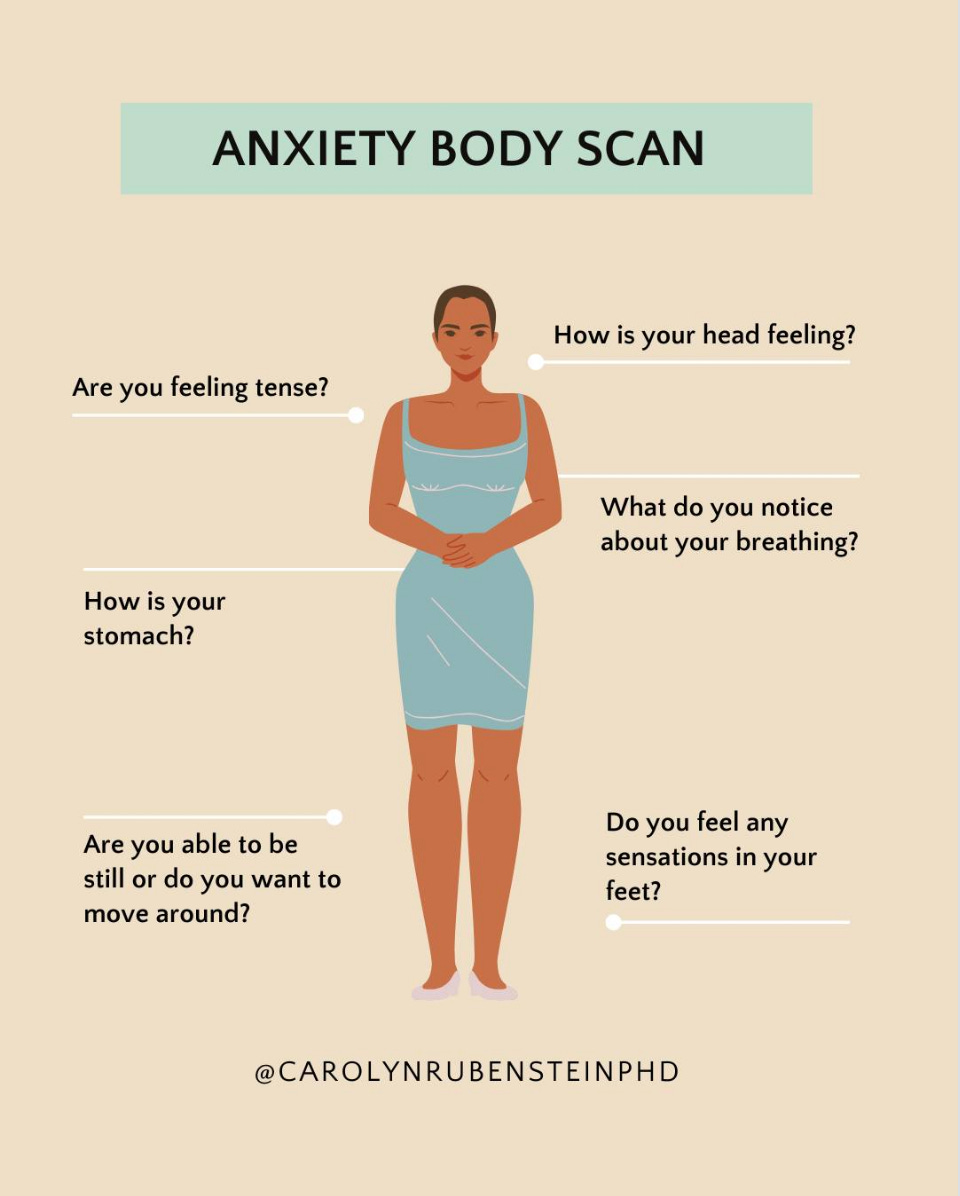
Breathwork can help too; focusing our attention on the breath can invite us into our current physical experience. The breath is always available as an anchor when our minds are sprinting ahead.
Exercise has also been surprisingly powerful in getting me more present in my body. I love feeling flushed and sweaty after a run, savoring the hot shower as a reward. I like the muscle soreness for a day or two after lifting something heavy. It’s a continuous reminder: I can do hard things!
Because, you know, capitalism
All of this requires s l o w i n g d o w n. It requires actively fighting our oppressive busyness culture and the equating of productivity with worth. It requires subscribing to a different paradigm: one that values rest4 and doesn’t believe in “laziness.”
A body with needs is inconvenient to capitalism. Capitalism would prefer you caffeinated, dissociated, and “fine.” It would prefer you push through hunger, ignore fatigue, override stress signals, and keep producing. Because stopping to feel your body often leads to stopping… period. Stopping to rest. Stopping to say no. Stopping to realize you’re not okay with the pace you’ve been living at. Or the system you’re living in.

Interoception interrupts the whole machine. Learning the language of our body helps us respond sooner, with more choice and care. And once we notice what our body is holding, we might start treating ourselves like living beings and not just brains in soup. We might start making different choices.
My body is voting on my mood all day long. Interoception is me finally reading the ballot. The more fluent I become in my own signals, the more I can treat emotions as information—not emergencies—and respond with care instead of reflex. And as a bonus, that care creates slack in the system: pauses, rests, no’s, boundaries.
In a culture that profits from your disconnection, paying attention is both regulation and resistance.
Anderson, C. A. (1989). Temperature and aggression: ubiquitous effects of heat on occurrence of human violence. Psychological Bulletin, 106(1), 74-96. doi: 10.1037/0033-2909.106.1.74.
This claim comes from Unmasking Autism by Devon Price (2022). But the research is actually quite nuanced, in part because (a) ASD is really heterogenous, and (b) ASD overlaps heavily with alexithymia, the inability to identify one’s own emotions, which may be actually what’s related to difficulty with interoception.
Safe: An Attachment-Informed Guide to Building More Secure Relationships by Jessica Baum (2025). I’m only halfway through but I can’t stop talking about it to everyone I meet.
Required reading: Rest is Resistance by Tricia Hersey (2022). One of my fav concepts/mantras from the reading I did during my career break.